


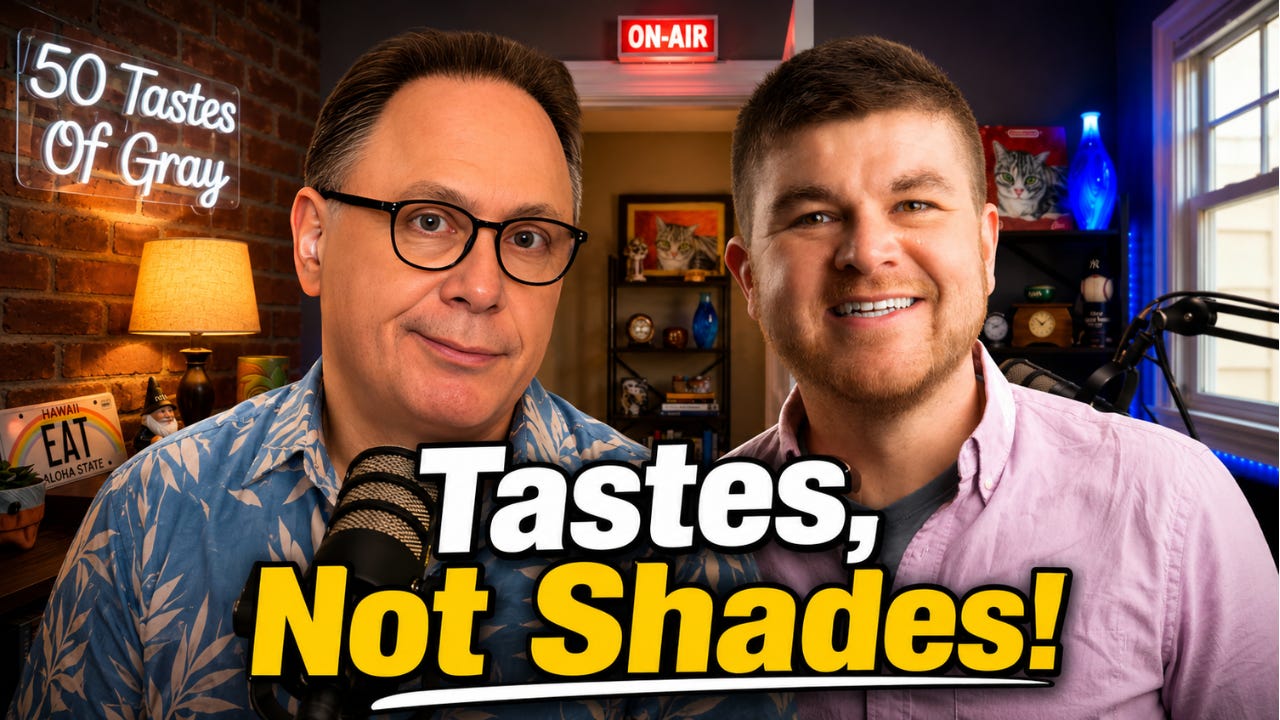
It was maybe 90 seconds into our conversation when Adam Barney called my show Fifty Shades Of Gray.
I corrected him. He blamed it on being a Friday afternoon in Boston and wanting something cold to drink. I believed him. And somewhere in that tiny exchange, the slip, the laugh, the easy pivot, I knew this was going to be a good one.
Adam is a lot of things. Leadership coach. Published author. Host of the podcast Is Anything Real? Dorchester resident. Father of two daughters who are definitively more Boston than he is. Proud owner of a 14-year-old basset hound-poodle mix named Wellington, after his own middle name, which goes back five generations on his paternal side, and which he uses professionally, in part, to honor that lineage. (The investors in his elevator pitch competition asked about the W, too. He’s had practice answering.)
But what struck me most about Adam Barney wasn’t any of his credentials. It was the sheer quantity of heartbeats he’s keeping track of.
Controlled Chaos as a Truth Serum
By the time we got deep into the conversation, the picture had filled in considerably: Adam lost his mother to bulbar-onset ALS twelve years ago. Last year, he spent most of his time in and out of emergency rooms with his father, who was diagnosed with hydrocephalus. His wife, who was working on the other side of the house during our recording, dogs in tow, finished four rounds of chemotherapy for breast cancer earlier this year. She just wrapped radiation. The family celebrated with a trip to the Dominican Republic, where the 6-and-9-year-olds discovered they could order virgin Miami Vices at the all-inclusive bar and proceeded to drink them with alarming enthusiasm.
Adam described his life as “constant controlled chaos.” But then he said something that stopped me:
“I used to think that chaos was an inconvenience. Now I think it’s a truth serum. You can’t fake who you are when the dog is throwing up and someone’s asking for a snack and you’re trying to remember what day it is.”
That’s not a platitude. That’s a man who’s actually been tested, reporting back honestly from the field.
His book, Make Your Own Glass Half Full: The Empowered Path to Optimism and Autonomy, grew directly out of those experiences. Not as a “here’s how I survived” memoir, but as a genuine argument that the tools that get you to where you are today are not the ones that will get you where you need to go. He now coaches leaders on exactly that gap. Transition leadership, he calls it. Reality-first. No performance, no coherence theater.
He used a phrase I haven’t stopped thinking about: performing coherence. His pitch to potential clients is almost disarmingly honest: if you’ve been doing it too long, you’ll probably recognize yourself in what he does.
The Resignation Letter on the Plane
Before he became a coach, Adam spent twenty years in corporate marketing. He managed $100 million in paid ad spend. He built teams. He led people up, not just across. And then, Labor Day 2021, a weekend in Punta Mita, Mexico with friends gave him four days of clarity he hadn’t been able to find anywhere else.
He wrote his resignation letter on the flight home.
He used something called the Regret Minimization Framework, a tool that asks you, essentially, which decision will your 80-year-old self be less able to forgive you for. He delivered the letter to his boss the Tuesday after Labor Day. No plan. No next thing lined up.
What followed was a year of leaning into his actual superpower: networking. Hundreds of 30-minute coffee conversations with people he’d never met. No ask. Just origin stories and honest exchange. Out of that came clarity about who he most wanted to help, leaders who don’t necessarily look like him or sound like him, but who have the ideas and the hunger to make things more equitable.
“I love working with the underdogs,” he said. “People who realize the tools that got them here won’t get them there.”
He didn’t arrive at that by reading a business book. He arrived at it by watching what happens to people, including himself, when they stop asking for what they actually need.
Music is the Maintenance
Here is what I can tell you about Adam Barney’s relationship to music: the two most important things in his home safe, alongside birth certificates and passports, are his concert ticket stub binders.
He’s been to over a thousand concerts. He has three framed posters above his monitor, the Woodstock 40th anniversary show where he saw Levon Helm before he died, a My Morning Jacket and Boston Pops collaboration from June 2006, and a 1970 Grateful Dead and Allman Brothers poster from RFK Stadium. He has the full 30-plus CD Woodstock box set in his basement, alongside roughly 3,000 other CDs.
He has Sonos speakers throughout the house because his brother-in-law was an early employee there. Music is simply on, all the time. His nine-year-old got into Cyndi Lauper not because anyone assigned her a listening curriculum, but because the house breathes music, and eventually these things seep into you.
The music section is the part of Adam where the armor fully comes off. It’s where you see what actually fills him up, what he reaches for when the caregiving and the coaching and the parenting and the grief pile on.
He told me what he uses music for: recharging the battery. Paying back what he calls energy debt. He was clear-eyed about the mechanism, some people run on empty until they crash. He’s decided to actively refill instead.
“Concerts fill my cup more than anything else,” he said. And you believed him, because he said it the way people say things that are simply true.
Three Closing Shots Worth Keeping
Adam’s parting wisdom arrived wrapped in music, which felt exactly right.
The first: he’s noticed that at concerts, when the crowd wants the chorus and the artist holds off, the restlessness that follows is a tell. They didn’t come for presence. They came for reassurance. He’s been both people. He knows the difference now.
The second: he used to treat job titles like festival wristbands, if he had one on his wrist, he felt like he belonged. But belonging, he said, doesn’t actually come from access. It comes from what you do with yourself once you get in.
The third: he’s grieving the disappearance of paper ticket stubs. Not sentimentally, but philosophically, because a stub is proof you were there. Now it’s trapped in an app. And there’s a version of this problem, he pointed out, that adults have inflicted on their whole lives: turning real experience into something they only access through metrics and devices and someone else’s definition of what counts.
He knows a guy in Canada who bought old Ticketmaster stock and now prints physical stubs. Adam’s only complaint is that there’s no bulk upload feature. Of course that’s his complaint. Of course. I get it.
Why the W
I asked him, right at the end, why he uses his middle initial professionally.
Wellington. Five generations on his father’s side. He’s the last male heir to the Barney name. And before he and his wife had kids, before the car, before the house, before the dogs, they got a basset hound-poodle mix and named him Wellington. Welly. Because he looks like he’s wearing a tuxedo, and because the name had to live somewhere.
That dog is 14 years old now.
“You see,” I told him, “you just answered the question of why I do what I do.”
Because you don’t get that story if you stick to the resume. You only get it if you let the conversation go somewhere real.
Adam W. Barney let it go somewhere real. I hope you’ll listen.
Adam’s podcast is Is Anything Real? and you can find him at AdamWBarney.com or on LinkedIn. His book, Make Your Own Glass Half Full, is available wherever books are sold. And if you know him, ask about Huntoon Rocks, the backyard concert series he’s dreaming into existence on the only Huntoon Street in the world.
This episode of 50 Tastes Of Gray is available now on YouTube and wherever you get your podcasts.
Matthew, this one caught me off guard in the best possible way.
Most people hear the career story. You somehow found the threads underneath it—the music, the caregiving, the chaos, the ticket stubs, the moments that quietly shape how we show up as leaders and humans.
I joined expecting a podcast conversation and left feeling like I’d spent an hour with someone genuinely curious about what makes people tick.
Also, I still maintain that “Fifty Shades of Gray” would dramatically increase your download numbers.
Grateful for the conversation, the friendship, and the reminder that the most interesting stories usually start after we stop talking about our resumes.