


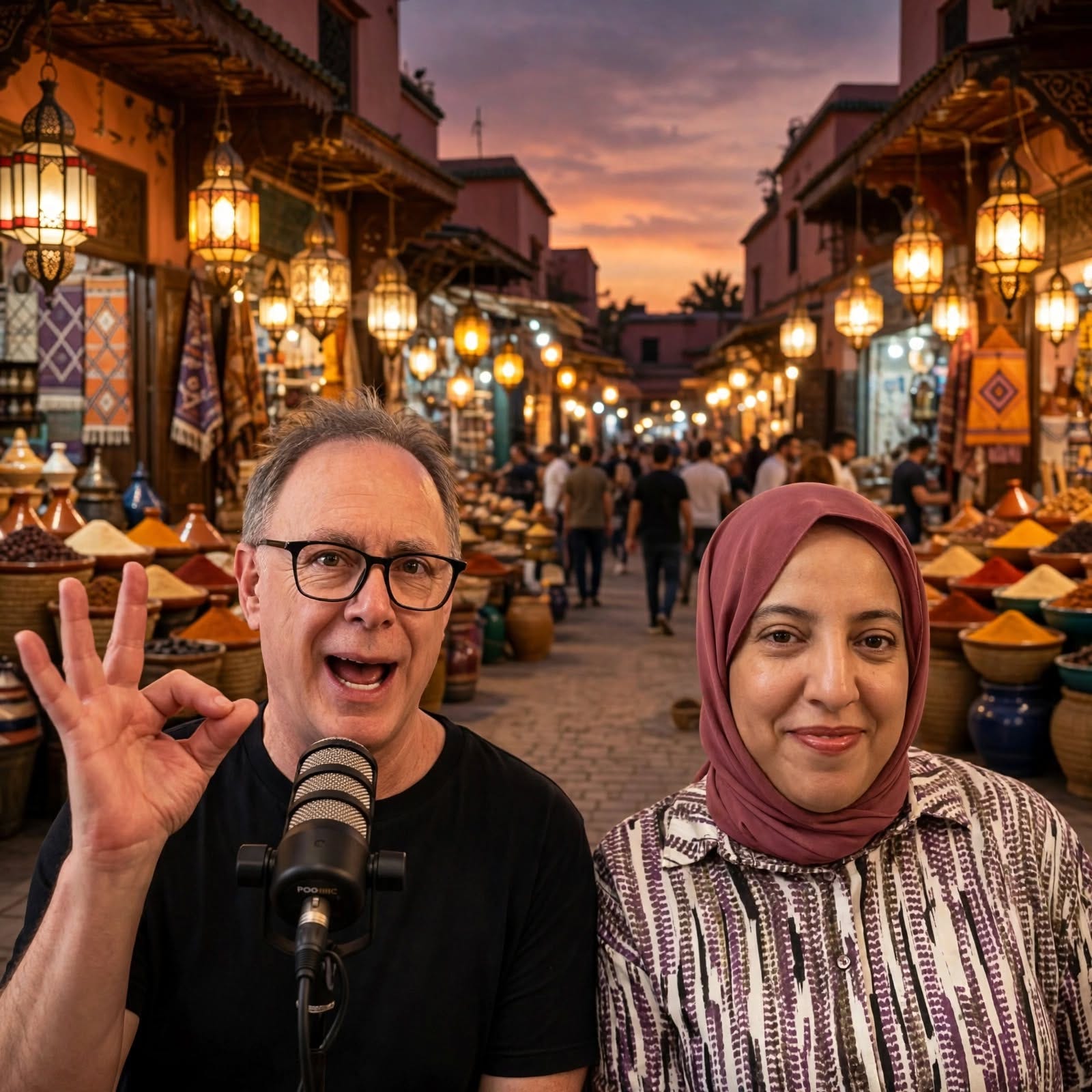
“They’re not squatting anymore. They’re sitting.”
Same men. Better chairs.
That is Siham Lahmine, laughing at me from Fez, answering a question I’d carried for decades. It was 8pm her time, morning mine, and we had a podcast to record.
The question came from the 1970s and 80s, when I first traveled Morocco with my sister and my girlfriend. I remember grown men squatting on the side of the road. Just sitting. Smoking. I remember women doing all the visible work. Cooking, cleaning, raising children, tending animals, wearing veils. I remember little boys swarming me, each one offering to be my guide to the Berber market.
I’ve carried that picture all these years. So I asked her if that Morocco still exists.
Her answer was the laugh, and then the rest of it. She calls it the North African radar. Everybody is watching you. Even when you think no one is, someone is watching from a window, from a door. So if you’re going to do something you’d rather not be seen doing, you do it on another street. Not where you live.
That’s a better answer than any guidebook will give you.
Siham runs culinary tours in Morocco, the first woman-owned in her country, featured in Forbes and Travel + Leisure. She could have pitched me that. She didn’t. She pitched me this:
“Food as inheritance, identity, and connection.”
That line stopped me. It’s exactly what I did for 16 years with Hawaii Food Tours.
Fez is conservative and authentic, she said. Wear a skirt above the knee and no one will say a word. But you will feel it. You will feel that you don’t belong, and you don’t want that feeling. Go with the flow of the neighborhood you’re in.
When in Rome... Morocco.
That’s exactly how I taught people to eat in Honolulu, away from the touristic areas. When I started Hawaii Food Tours in 2004, I wasn’t selling plates. I was selling how to belong for a few hours. How to wait. How to be a guest.
Siham reminded me of that.
I asked her my favorite question, what did you eat today? Bissara. Fava bean soup, but not soup. Thick. Poured into a tagine so it takes on the clay, then olive oil, cumin, chili if you want it. Eaten with bread. Simple. Her favorite.
Then she walked me through her country dish by dish, the way I used to walk people through the real Honolulu. I’ll give you two.
Tanjia is not tajine. It’s a clay pot with a head on it, meat and spices inside, buried in hot ashes for three hours. How do you know it’s done? You shake it. If the bone isn’t sloshing in water anymore, if the sauce is thick, it’s done. The meat is so tender.
Medfouna is from the Sahara. It means “the buried,” because it used to be cooked under the sand. A nomadic pizza, she called it. She doesn’t like the word Berber. It means barbarian. It’s what the Romans called the Amazigh.
The rest is in the episode. Pastilla, harissa, the Friday couscous. You’ll want to hear her say it.
What I want to tell you about is her mom.
Her mom’s kitchen is her kingdom. Those were Siham’s words. “You cannot go near to her.” Siham and her brother are grown adults. They offer to help. Mom says yes, yes, yes... then starts nudging you out of the way without even noticing. She has cleared out her sisters, her aunties, her daughter who is a fighter, and her son who lives in Germany and cooks for himself there but comes home and says, “I give up.”
I laughed out loud. I told Siham I wish people respected my kitchen like that. It’s my zen place too, but I can’t keep anyone out without police crime scene tape.
“You need to use my mom’s techniques,” she said. “Trust me. Everybody will go outside.”
But her mom urged a different path for Siham. “I couldn’t go to university. I couldn’t get my BA. So this is my dream. I want you to make my dream come true. Just dedicate your time to studying.”
Her mom would bring her orange juice while she studied.
Siham’s only job was to build a career and bring home that degree. She did. Linguistics, at Sidi Mohamed Ben Abdellah in Fez, then into tourism. She speaks Arabic, French, English, and for two years, Mandarin. Not to sell tours to Chinese travelers. Because “language is access.” She wanted to go to China without speaking English.
That’s why she showed up for our time together in purple, her favorite color, with a scarf matched carefully. She was raised by a woman who believed in doing things properly.
Her mom stayed in the kitchen so her daughter could leave it. And her daughter built a business out of what happens inside it.
We talked about eating with hands. In Morocco, she said, it brings baraka. Bliss. Blessing. Her grandmother would take couscous, squeeze it with vegetables and a little meat, roll it in her palm into what Siham calls the royal ball, and feed it straight into her grandchildren’s mouths. That’s how she spoiled them. From a tagine, everyone eats from the same dish, holding bread, scooping with thumb and two fingers.
I remembered that from Hawaii. How intimate it is. How a thousand years ago everyone ate this way, and some places kept the tradition because it means something.
Then I asked what smell Morocco gives her that she can never forget.
Orange blossom. End of April, May, though they have it all year. They don’t cook with it. They refresh their faces with it. Their hands. They flavor tea with it.
That’s the Morocco she carries.
Mine was men squatting on the road in the 70s and 80s.
Hers is orange blossom water on her hands in May.
That’s why I wanted her on 50 Tastes Of Gray. Two people comparing the Morocco they carry in their bloodstream. Hers is truer than mine now, because she lives it. Mine is still real because I saw it.
Near the end, she said, “We’re still the country that spends many time in the kitchen preparing a dish.” Every meal takes time, and a family to sit down and share it.
That’s what I was trying to protect in Hawaii. Not just poke or shave ice.
The table. The waiting. The hands.
If you want to find her, start with Instagram: @sihamlahmine. The tours live at @moroccotravelorganizer. But she asked me to point you to her, not the company.
“There are many businesses worldwide. For me this is a title and a logo. But it’s more you’re working with Siham.”
I get that. I had a logo once too.
People were working with Matthew.
P.S. The full episode dropped on YouTube this week. We talk about the radar, the royal ball, and why you should never try to fight Siham’s mom for the stove.

In the background of this conversation seems to be the experience you both share of food not being separate from everything else. Both of your whole lives are a meal and actual food is just a small part of what makes it bountiful and nourishing. The orange blossom, the feeding by hand, the street odors, neighbors and eyes registering each change and move, the rightness of it all, or using a subtle look to adjust the community as needed. I was very fed by these impressions.
I love the parallels you draw between her food tour company in Morocco and the one you ran in Hawaii: "She walked me through her country dish by dish, the way I used to walk people through the real Honolulu."
Then there's the common thread with her mother, how she takes control of her kitchen with a look and a gentle hip thrust the way you – if given the chance – would do the same with crime scene tape.
But this is what really stands out, this gem: "Her mom stayed in the kitchen so her daughter could leave it. And her daughter built a business out of what happens inside it." Man, that's insight. That's good writing.