


I’ll be honest about my own ignorance going in.
When Dr. Saravanan Thangarajan agreed to come on 50 Tastes Of Gray, I had a selfish and slightly embarrassing worry: I’m going to struggle to understand him.
Saravanan speaks with a thick, beautiful Tamil-accented English, Chennai through and through. It’s musical, it’s very fast, and my American ear, frankly, is quite dumb. It was trained on garbage.
First, it was New Yawk, my relatives doing the whole “toity-toid and toid” thing on the stoop. Then it was Valley Girl California, “like, oh my God, fer sure, fer sure.” And now for the last twenty years, it’s been podcast-bro English, “like, so, at the end of the day, let’s unpack that, let’s double-click and drill down, maybe do a discovery call.”
So when Saravanan speaks, with precision, with a Tamil rhythm, with real science behind every sentence, my toity-toid / Valley-Girl / podcast-bro brain went, “This is going to be hard work.”
I was completely wrong.
His episode is now outperforming every show I’ve done in well over a year.
Why? Because I underestimated the audience, and I underestimated him.
Dr. Saravanan Thangarajan is not just a global health scientist at Harvard T.H. Chan School of Public Health and the Lakshmi Mittal South Asia Institute. On paper, yes, he’s that, a serious academic who works on climate-linked maternal mental health, who can talk business, life, medicine, and politics.
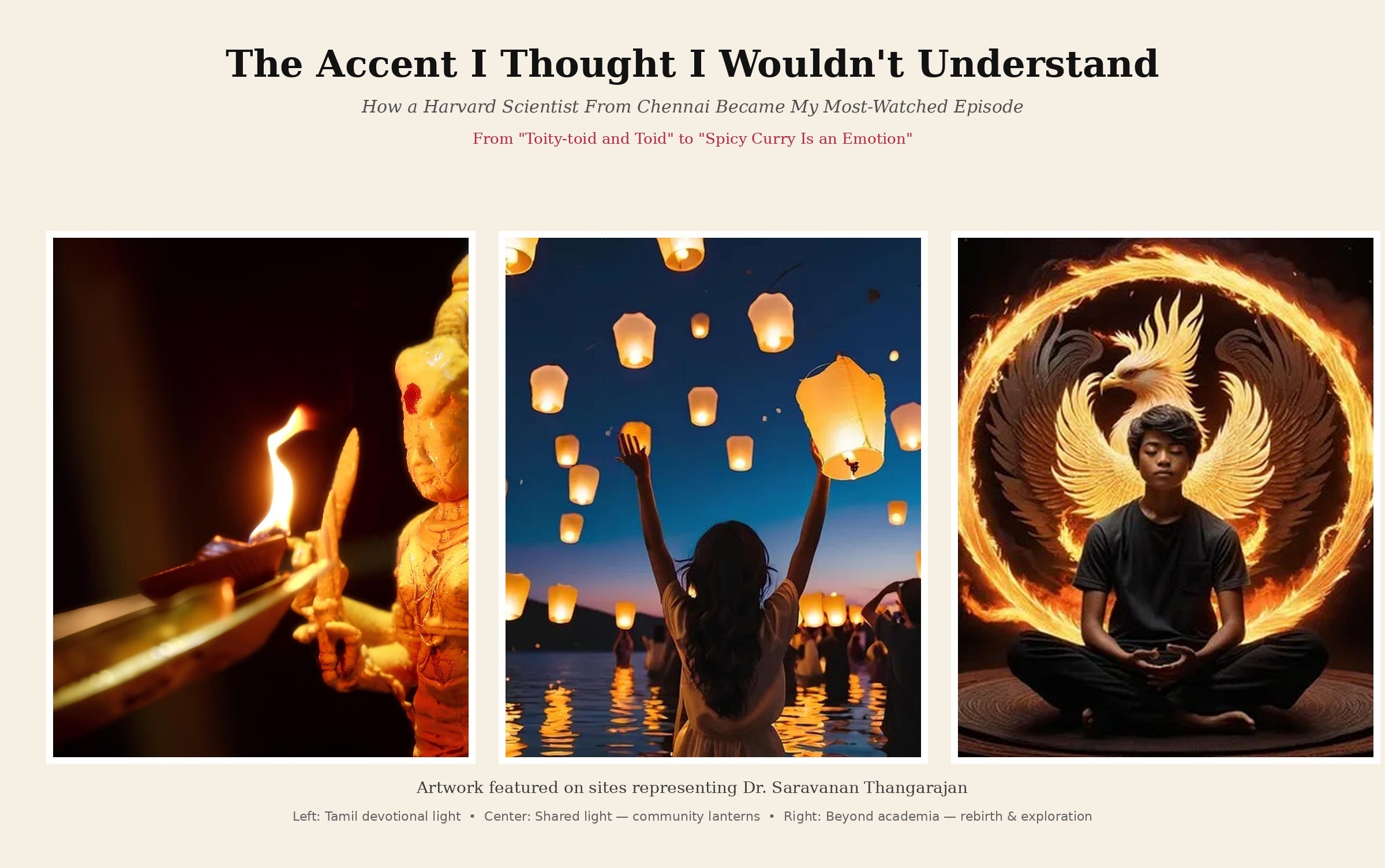
But in my studio, he was something else. He was delightful. Thoughtful. Disarmingly funny. And quite gifted as an artist, the kind of mind that thinks in images as much as data. On sites representing his work, you’ll find exactly that range: a Tamil devotional lamp glowing in the dark, a community releasing lanterns over water, a figure in meditation surrounded by a phoenix of fire. Tradition, shared light, rebirth. It’s not so different from his science, or from why he came on this show.

The moment that cracked it for me was when I asked what he’d eaten today.
“Rice with spicy curry. I cannot be without spicy,” he said. “It’s kind of emotion.”
That one line explains the whole 50 Tastes Of Gray thesis better than I ever could. He’s thousands of kilometers from home, and a plate of curry is how he reconnects to his home, his emotions, his feelings. For him, spice isn’t heat. It’s memory. It’s Tamil identity on a stainless steel plate.
We talked about medical tourism, the same procedure that costs $5,000 here costs $200 there. We talked about robots vs. human touch, how robotic precision will never beat human judgment. We talked about Harvard, where, as a proud Tamil man, he told me he never had to hide who he is.
And then I asked him the question I always ask people like him: “Your background is usually suited to shows that real smart people host, not people like me. Why say yes to this?”
He laughed. He said he’s spent his life in the professional domain. Academic research. Comfort zone. He felt a little undressed outside it. He wanted a break. He wanted to try something beyond work. This was his first time ever doing anything like this, a chance to explore himself, to think about things that had never struck him before.
That’s when I got it. The accent wasn’t a barrier. It WAS the show.
People don’t come to 50 Tastes Of Gray for polished NPR English. They come to hang like a couple of buddies. They come for lasagna with Jesus and Obama. They come for real.
And the numbers prove it. The Indian diaspora, Chennai, Tamil Nadu, Indians abroad missing home, found him. They shared him. They heard “spicy curry is an emotion” and knew exactly what he meant. My worry about “Will people understand him?” became the very reason they watched: because he sounded like home.
Saravanan taught me something I should have already known after 100+ episodes: clarity is not about accent. It’s about having something true to say.
He did. And you heard it. Or you can, just below…

Strap on your headphones. This is 50 Tastes Of Gray and you have only had one.
The images online representing Saravanan’s work … that alone points to someone who’s really interesting, how he “thinks in images as much as data.” He’s clearly more than a spreadsheet-driven genius.
And I love how one plate of food immediately whisks him home. It’s probably true for everyone, but he really makes that abundantly clear.