


THE SWEET ’N LOW OUTLAW
Every family has its mythology.
Some families pass down heirlooms.
Some pass down recipes.
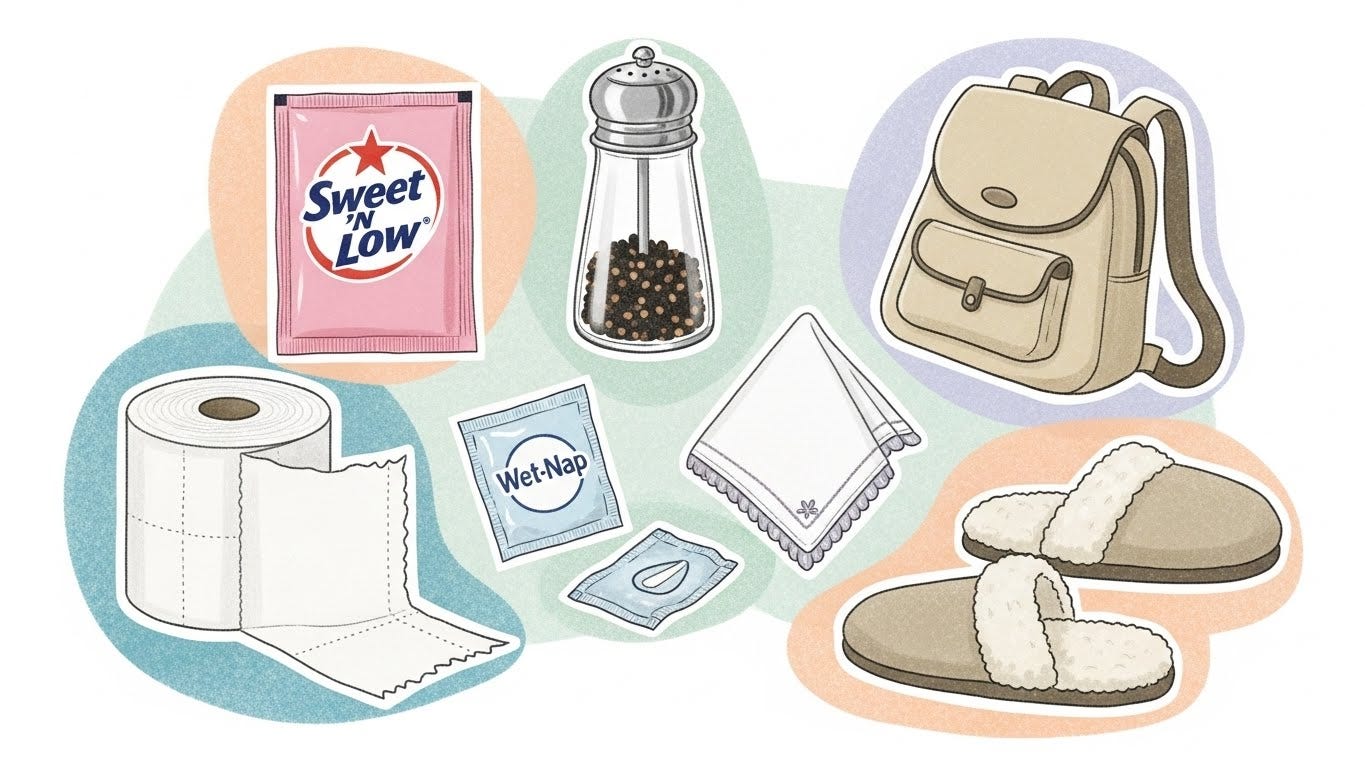
Mine passed down stories, stories about my dad, Jerry, known to my cousins as Uncle Jelly, a man who lived his life like a one‑man vaudeville act with a cloth hanky and a backpack full of contraband.
He wasn’t a criminal. Not in any legal sense.
But he had a lifelong habit of stealing things that no self‑respecting thief would ever bother with.
Sweet ’N Low packets from every diner we ever visited.
Toilet paper rolls from Le Boulangerie in Los Angeles.
Wet‑Naps from Las Vegas casinos, as if he were preparing for a barbecue‑related natural disaster.
He didn’t steal valuables.
He stole supplies.
Consumables.
The kinds of things restaurants buy in bulk and never think about again.
And he did it with the confidence of a man who believed, deep in his bones, that he was balancing the cosmic ledger. Getting even. With whom? For what? The price of coffee? The French? The indignity of life?
We never knew.
But the thefts were only the opening act.
THE NOSE BLOW HEARD ’ROUND THE WORLD
If you’ve never heard a grown man blow his nose with the force of a collapsing building, count yourself lucky. My father could clear his sinuses with a sound that made entire restaurants pause. Forks froze mid‑air. Conversations died. Infants reconsidered their life choices.
And then, because the universe has a sense of humor, he would inspect the results. Proudly. Curiously. Like a jeweler examining a diamond.
He used a cloth hanky, which somehow made it both better and worse.
Mom would wince.
Ivy would stare at the ceiling.
I would pray for spontaneous combustion.
This was our normal.
When he got superhot, he’d threaten and say ‘I’ll flog you unmercifully,’ and somehow it only made us laugh harder.
THE BACKPACK BEFORE BACKPACKS EXISTED
Long before backpacks became a thing, before they were cool, before they were practical, before they were sold at REI for $129.99, my dad carried one everywhere.
Now I understand why.
The Sweet ’N Low.
The Wet‑Naps.
The toilet paper rolls.
The cloth hanky.
The peppermill theatrics.
The emergency supplies for whatever scenario he believed might unfold at any moment.
He wasn’t stealing.
He was stocking.
He was the original prepper, but instead of canned beans and flashlights, he was preparing for a future in which Sweet ’N Low was currency, Wet‑Naps were gold, and toilet paper was a luxury item long before 2020 proved him right.
THE DRIVING DOCTRINES OF JERRY DELANO GRAY
Dad’s relationship with driving was… fluid.
Some days he’d preach, with the solemnity of a rabbi,
“Better to arrive an hour earlier in one piece…”
And the very next day he’d bark,
“Let everyone else drive defensively!”
Riding with him was a spiritual exercise.
You never knew whether you were in the hands of a cautious sage or a man auditioning for a stunt‑driving team.
And then there was his personal economic theory:
“Just starting the car costs a dollar,” he’d say, with the authority of a man who had personally audited the Department of Transportation. “So be sure you have your best route planned.”
This from the same man who would, without hesitation, take me and my buddies to Tommy’s, the legendary chili dog stand in downtown L.A…. at two in the morning.
No route planning.
No cost analysis.
Just pure, spontaneous, chili‑soaked joy.
THE “KEET” ERA
When Dad got excited, or angry, or frustrated, or mildly inconvenienced by the existence of other humans, he lost the ability to pronounce the word keep. It came out as “keet,” every time, without fail.
“Keet quiet!”
“Keet your hands to yourself!”
“Keet it down back there!”
It was linguistic slapstick.
The more he tried to correct it, the worse it got.
By the third “keet,” Ivy and I were already in silent hysterics, and Mom was staring straight ahead like a woman trying to transcend her physical form.
And when he got really hot—superhot—he’d unleash one of his signature lines:
“I’ll flog you unmercifully!”
or
“I’ll split your head wide open!”
These were not frightening.
These were vaudeville.
Delivered with the theatricality of a man who had watched too many black‑and‑white gangster films.
We weren’t scared, we were doubled over.
THE DINNER‑TABLE FIREWORKS
Dad also had a lifelong inability to handle hot food, not spicy food, just temperature. My mom eventually gave up trying to serve him dinner with the rest of us and started placing his plate on the table a full fifteen minutes early, like he was a fussy dignitary with special requirements.
And even then, even with the food cooled to a medically safe temperature, he’d attack it with the peppermill like he was trying to summon a genie.
The result was always the same:
a coughing fit,
a slurp,
a gasp,
a wheeze,
and the sudden loss of his voice.
Every time.
Without fail.
And every time, Ivy and I would dissolve into laughter so intense it felt like cardio.
THE ENCORE: THE HEAD‑SMACK
And then there was the encore, the moment that signaled we had entered the bonus round of the Jerry Experience.
Dad would sit there, arms folded across his chest like a man guarding state secrets, and slowly drift off to sleep. Not a gentle nod. Not a polite doze.
No.
He’d tip back, further and further, until gravity made the executive decision for him and his head snapped back and smacked the wall behind him.
A clean, resonant thwack.
Every time.
Mom would gasp.
Ivy would cover her mouth.
I would dissolve into silent hysterics.
It was one of Dad’s greatest hits, an involuntary physical punchline delivered with perfect comedic timing.
THE QUIET THAT CAME AFTER
In his last days, the soundtrack of our home changed.
The booming voice softened.
The theatrics faded.
And what remained was the sound of slippers shuffling across the floor.
That soft, uneven rhythm, shuffle, drag, shuffle, still haunts me.
It was the sound of a man who had lived loudly now moving through the world carefully, slowly, almost tenderly.
I still shiver when I hear that sound in my memory.
It is the echo of love, and loss, and time doing what time always does.
But the very last sound we shared, the one that sits above all the others, was simple.
“I love you.”
“I love you too.”
After a lifetime of chaos, comedy, contradictions, and Sweet ’N Low heists, that was the final exchange.
No theatrics.
No peppermill.
No “keet quiet.”
Just love, spoken plainly.
And somehow, that’s the truest version of him.
A man who lived big, laughed big, embarrassed us big, loved us big, and left behind a story so rich and ridiculous and tender that I can still hear it, even now.
Every family has a mythology.
This is mine.
And it ends not with a punchline, but with a whisper.
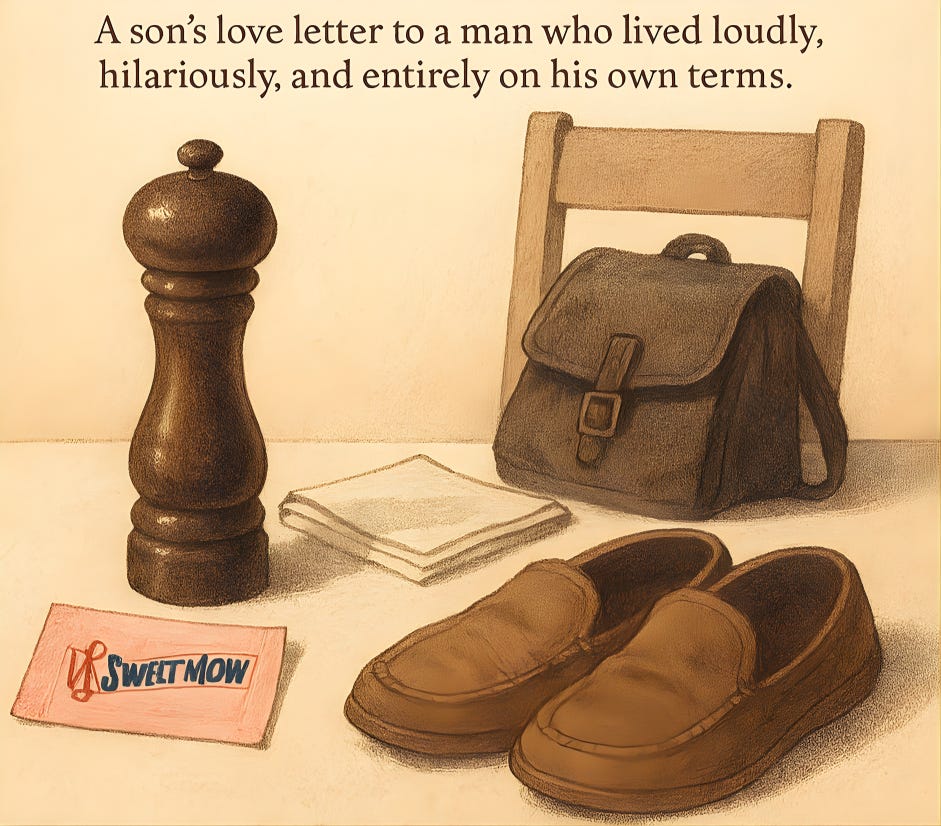
Matthew, the caption on the last image of this essay says it all: "A son's love letter..."
Indeed...
Your ability to blend hilarity with aching tenderness is truly unique. The pilfered items, the Richter-scale nose blowing, the 5-alarm-fire reaction to lukewarm soup ... And then we see the soft slipper shuffling, ending with: "I love you too..." Wow.
By the way, Uncle Jelly and my mom are apparently cut from the same cloth (shameless plug here): https://thepositivepessimist.substack.com/p/goodbye-mom
Finally, with essays like this, I only have one thing to add: Keet on writing, my friend.
This is great, Matthew. Thanks for sharing.